School breaks are always a good time to get started to help your children learn to memorize math facts. (8+7, 10-2, 5×4)
1st, Make sure they can show what the math facts mean. Children can use counters, draw pictures, and tell a word math story. Note, children shouldn’t be asked to memorize an answer to a math fact until they can show what it means.
2nd, Check which facts they know automatically, meaning without having to count out answers. Use a commercial pack of “flash” cards to check if addition, subtraction, and or multiplication facts are memorized. Ask first: “How much is 2+2?” You will see how fast the answer is. What happens when you show a fact and the answer is not known? Does your child stop, think, and count silently or use fingers to get the answer? If yes, that fact is not a known fact. But, it is good that they understand how to get the answer.
Note: So that it doesn’t take forever to go through the math facts when a child knows just some answers, tell them to say, “I don’t know” for the facts they don’t know. If a fact comes up that you think they know, ask, “Are you sure?” Sometimes, if they are saying, “I don’t know,” for a lot of facts in a row, they aren’t attending to the actual fact.
3rd, You can choose to make a math fact card for each of the known facts so they can feel good about the ones they know. If they only know the one + a number facts, make a fact card for each. If they know a bunch of math facts, you can choose to make a card for just half of those. (1+2, 3+1, 1+4, 1+5, 6+1, 7+1, 1+8. 9+1) The same goes for the zero facts. (1+0, 0+2… 2-0, 5-0… 3-3, 6-6..)
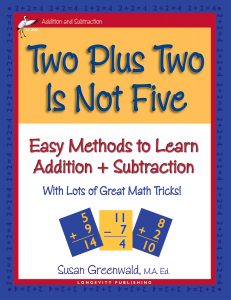
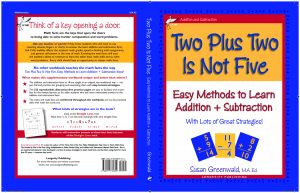
4th, Teach new facts using strategies to help them memorize the answers. Two Plus Two Is Not Five: Easy Methods to Learn Addition and Subtraction and Five Times Five Is Not Ten: Make Multiplication Easy are two reproducible workbooks that were written to help children remember the answers! See sample pages in this website, and read the testimonials from parents and teachers.
5th, Give written practice on the known and newly taught facts. Both workbooks have lots of practice and review pages!
6th, Show how these same facts are used in real-life word math problems.
For more information or if you have questions, please email me! Also, ask if you want to know what to do when the math fact packs become too large to practice daily. info@longevitypublishing.com.
As students are learning and memorizing addition and subtraction facts, you can begin to teach place value, and have them learn to add 2, 3, and 4-column numbers. For example: If they know 5+5, 2+2, and all the 1 + a number facts, and 10-5, 6-3 and all the number -1 facts, give them problems such as these.
52 195 451 60 86
+12 + 15 +156 – 1 -13
Addition and Subtration: Beyond Math Facts is a workbook which can be used to help transition students from the isolated math fact to working with math facts in larger numbers. The practice pages follow the same sequence as Two Plus Two Is Not Five to introduce the math facts. There are also word math problems.